
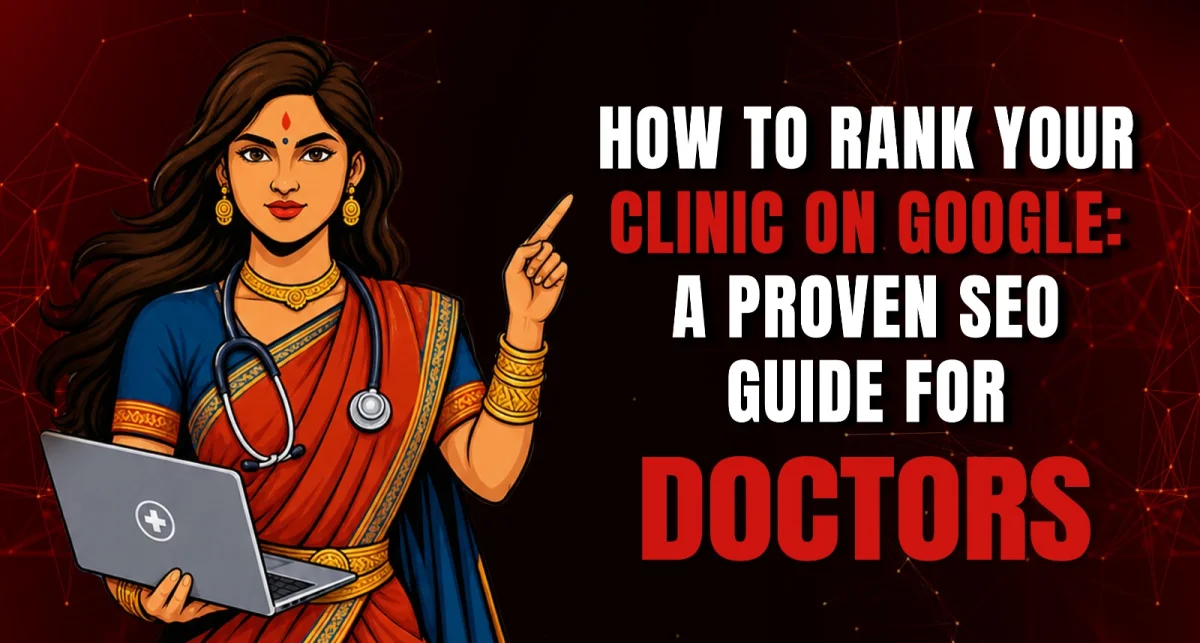
Ten strategies to help clinics appear when patients search — built around credibility, patient trust and ethical compliance, from the SEO squad at Technical Avengers.
Technical Avengers Pvt. Ltd. is a business growth agency working with clinics, hospitals and healthcare practices across Vijayawada, Amaravati and Andhra Pradesh. This guide covers what we implement when a practice hires us to improve its search visibility — and what we deliberately don't do.
Here's what happens before a patient walks into your clinic.
They feel a symptom. They search it. They read for twenty minutes and frighten themselves. Then they search "orthopaedic doctor near me" or "best dermatologist in Vijayawada" and they choose from what Google shows them.
By the time they call your reception, the decision is already 80% made. It was made on a map listing, a star rating, a handful of reviews and whether your clinic looked like somewhere a person could trust with their health.
Most doctors we speak to find this uncomfortable. They spent a decade training and now the deciding factor appears to be a Google profile.
But look at it differently. Patients aren't choosing based on marketing they're choosing based on the only signals available to them.
If a genuinely excellent practitioner is invisible, patients end up with someone less qualified.
Making yourself findable isn't self-promotion. It's making sure the people who need your expertise can actually reach it.
Here's how that's done, ethically.
First: A Note on Compliance
This matters more for medical practices than any other category, so it comes before the tactics.
Medical practitioners in India operate under professional conduct regulations that restrict advertising and direct solicitation of patients. The National Medical Commission's code of ethics governs what a doctor may and may not do to attract patients, and the specifics have been revised more than once in recent years.
Nothing in this guide is legal advice. Before implementing anything here, confirm current requirements with your state medical council, your professional association, or a healthcare compliance advisor. Regulations differ by council and change periodically.
What we can say from practice: there is a meaningful difference between advertising and being findable, and every strategy in this guide sits deliberately on the findable side.
Generally accepted as factual disclosure:
Your name, qualifications, registration number, specialty and experience
Clinic address, contact details, consultation hours
Services, procedures and conditions treated
Educational content that helps patients understand their health
Generally treated as problematic:
Superlative claims — "best," "top," "number one"
Guaranteed outcomes or cure claims
Before-and-after imagery in restricted specialties
Testimonials that make clinical claims
Incentivising or paying for patient reviews
Comparative claims against named practitioners
We build clinic visibility using the first list only. It works — and it doesn't put a registration at risk for a marketing gain.
Where Patients Actually Find Doctors
A quick structural point that determines everything below.
Search "dermatologist near me" and Google returns:
The map pack — three practices with a map
Sponsored results
Blue links — usually dominated by Practo, Justdial, hospital sites and directories
The overwhelming majority of calls and direction requests go to the map pack. Below it, you're competing against Practo's domain authority and generally losing. In the map pack, you're competing against the practices nearest you — and Google shows individual businesses there, not aggregators.
That's the winnable fight, which is why strategies 1 through 4 concentrate there.
Strategy 1: Build a Complete, Accurate Google Business Profile
For a clinic, this is the highest-leverage asset you own, and it costs nothing.
Practical implementation:
Claim and verify your listing; reclaim it if a directory or previous occupant created one
Set your primary category precisely — "Dermatologist," "Orthopedic Surgeon," "Pediatrician," "Dental Clinic" — not the generic "Doctor"
Add secondary categories that genuinely apply: Medical Clinic, Diagnostic Centre, Physiotherapist
Keep name, address and phone identical across your website, Practo, Justdial and every directory. Mismatches weaken your ranking
List consultation hours precisely, including separate morning and evening sessions if you close between
Add attributes: wheelchair accessible, parking, online appointments, women-led practice where applicable, languages spoken
Add an appointment booking link that points to your own system where possible
Write a factual description covering specialty, qualifications and locality — no superlatives
Keep hours updated for conference travel, festivals and leave
If multiple doctors practise at one address: each practitioner can generally maintain an individual profile alongside the practice profile, provided each has distinct public-facing hours and contact details. Verify current Google policy before setting this up, as the rules around practitioner listings have shifted.
Strategy 2: Handle Reviews Carefully and Never Incentivise Them
Reviews are the strongest ranking factor you can influence, and for healthcare they're also the strongest trust signal. But this is the area with the most ethical exposure, so the approach differs from other industries.
Practical implementation:
Never pay for, incentivise or trade anything for a review. Beyond Google's policies, this creates professional conduct risk
Place a QR code at reception linking to your review form — passive availability, not solicitation
Train reception to mention it neutrally at discharge: "if you found today helpful, a review helps other patients find us"
Never solicit reviews during a consultation, or from a patient in distress or mid-treatment
Respond to every review, but never confirm that a reviewer is your patient. That acknowledgement is itself a confidentiality breach
Use a template for negative reviews: thank them, state that you take feedback seriously, invite them to contact the clinic directly. Never discuss any clinical detail publicly, even in defence
Maintain a steady trickle rather than bursts
That confidentiality point catches a lot of practice. A well-meaning reply reading "we're sorry your knee replacement recovery was difficult" has just disclosed a patient's medical procedure in public.
Strategy 3: Build Individual Pages for Every Condition and Treatment
This is where clinics leave the most traffic on the table, and it's the closest thing to a durable competitive asset in medical SEO.
Patients rarely search for a doctor first. They search for a symptom or a condition, then look for who treats it.
Search patterns that matter:
Type | Examples |
Symptom-led | "knee pain treatment," "hair fall treatment near me," "chest pain causes" |
Condition-led | "PCOS treatment in Vijayawada," "diabetes specialist near me" |
Procedure-led | "root canal cost in Vijayawada," "laparoscopic surgery near me," "IVF treatment Amaravati" |
Specialist + locality | "dermatologist in Mangalagiri," "child specialist near Benz Circle" |
Question-led | "when should I see a cardiologist," "is knee replacement painful" |
Practical implementation:
Create a dedicated page for each significant condition and procedure you treat — not one "Services" page listing twenty items in bullet points
On each page cover: what the condition is, common symptoms, when to seek care, diagnostic approach, treatment options, what recovery involves, and realistic expectations
Write for a worried patient, not a peer. Plain language, no jargon without explanation
State facts, avoid outcome guarantees. "Most patients return to normal activity within six weeks" is credible. "Guaranteed pain-free results" is not, and may breach conduct rules
Include an FAQ answering what patients actually phone to ask: cost range, duration, insurance, recovery time
Add a clear next step — appointment link and tappable phone number — on every page
Link each condition page to the treating doctor's profile page
A practice with thirty well-built condition pages ranks for hundreds of long-tail searches. A practice with one Services page ranks for almost nothing.
Strategy 4: Establish E-E-A-T Through Doctor Profile Pages
Google classifies medical content as YMYL — "Your Money or Your Life" — and applies its highest scrutiny to it. Health pages are assessed heavily on Experience, Expertise, Authoritativeness and Trustworthiness.
Also Read: How We Build Brand Identities That Command Attention
Practically, this means Google wants to see that a qualified human stands behind the content.
Practical implementation:
Give every practitioner a dedicated profile page with a real photograph
Include full qualifications, medical registration number, years of experience, specialisations and sub-specialisations
List institutional affiliations, fellowships, and hospital attachments
Link to published papers, conference presentations and professional memberships
List languages spoken — genuinely important in a bilingual region
Add a byline to every condition page: "Reviewed by Dr. [Name], MBBS, MD, Reg. No. [X]," linked to the profile
Add Physician schema markup to each profile page
Keep an "About the Practice" page covering establishment year, facilities and equipment
Display registration details in the footer
Anonymous medical content struggles to rank now, and should. Named authorship with verifiable credentials is both an SEO requirement and the right thing to do.
Strategy 5: Make Appointment Booking Frictionless
Ranking gets a patient to your page. Booking friction loses them there.
Practical implementation:
Put a tappable phone number in the header of every page — many patients still prefer calling
Add online appointment booking if your practice can support it
Enable WhatsApp enquiry, which is often the lowest-friction channel in this region
Set clear expectations: consultation fee range, average wait time, whether walk-ins are accepted
Show which insurance and cashless providers you accept
Ensure a reply within business hours — an unanswered enquiry is a patient who booked elsewhere
Track how many enquiries convert to appointments, and where the drop-off happens
Strategy 6: Publish Patient Education Content
This is the slowest strategy and the one that compounds hardest and for doctors, it doubles as genuine service.
Practical implementation:
Answer questions patients actually ask, in the words they use
Cover seasonal and regional health topics: dengue prevention, summer heat illness, monsoon infections, festival-season dietary concerns
Explain procedures honestly, including risks and limitations. Balance builds trust
Publish consistently — twice a month sustained beats a burst followed by silence
Attribute every article to a named practitioner
Include a medical disclaimer noting content is educational, not a substitute for consultation
Add publication and last-reviewed dates, and actually refresh older articles
Never make claims your specialty's evidence base doesn't support
Realistic timeline: three to six months before meaningful movement. Do strategies 1 through 4 first.
Strategy 7: Add Medical Schema Markup
Schema is code that tells search engines precisely what your practice is. It's invisible to patients and highly visible to Google.
Practical implementation:
Add MedicalClinic or MedicalBusiness schema to your homepage
Add Physician schema to each doctor's profile page with qualifications and specialty
Add MedicalCondition and MedicalProcedure schema to relevant condition pages
Include hours, geo-coordinates, accepted insurance and languages
Add FAQPage schema to your FAQ sections
Validate everything with Google's Rich Results Test before publishing
Almost no clinic in the region has implemented this. It's one of the fastest technical wins available.
Strategy 8: Build a Website That Works Under Pressure
Remember the context: someone may be reading your site at 2am, worried, on a phone, on poor mobile data.
Practical implementation:
Mobile-first, always. Nearly all health searches happen on phones
Load time under three seconds; compress every image
Above the fold: specialty, locality, hours, tappable phone number
Address opening directly in Maps in one tap
Separate pages for each branch if you operate multiple locations
Readable typography — a substantial share of your patients are older
Hours as text on the page, not inside an image
Secure the site with HTTPS. Non-negotiable for anything handling health enquiries
If you collect patient information through any form, ensure your data handling meets applicable privacy requirements
Our Code Panther unit builds these end to end, but a well-structured site covers most single-location practices.
Strategy 9: Build Citations and Local Authority
Citations are mentions of your name, address and phone across the web. Google cross-references them to verify you're real and located where you claim.
Practical implementation:
Fix your exact NAP format in writing and use it identically everywhere
Claim and complete: Practo, Justdial, Lybrate, Sulekha, Apple Maps, Bing Places
Ensure hospital affiliation pages list your details consistently
Get listed in local health directories and Vijayawada city guides
Contribute expert commentary to regional publications and health segments — this builds authority and earns links
Speak at community health camps and awareness events; coverage delivers citations naturally
Audit listings quarterly, particularly after a number or address change
Strategy 10: Track Enquiries Without Compromising Privacy
Most practices have no idea which channel produces patients, but healthcare tracking carries obligations other industries don't.
Practical implementation:
Review Google Business Profile Insights monthly: search views, map views, calls, direction requests
Watch the split between discovery searches (found you by specialty) and direct searches (searched your name). Rising discovery means SEO is working
Install Google Analytics and Search Console, configured to avoid capturing personal health information
Never pass condition-specific data into advertising platforms — this is both a privacy issue and a policy violation on most ad networks
Use a separate tracked number to measure search-driven calls
Ask new patients how they found you and log it for a month
Measure appointments booked, not just traffic
Should a Clinic Hire an SEO Agency?
An honest filter.
Handle it yourself if you or your practice manager can spare a few hours a month. Strategies 1, 2 and 5 — profile, reviews, booking — are manageable in-house and deliver most of the early gain.
Get help if you need the condition pages, doctor profiles, schema and technical foundations built properly. This is where medical SEO becomes genuinely specialised.
Read More: How to Rank Your Café on Google: A Proven SEO Guide
Hire an agency if you're multi-practitioner, multi-location, or launching — where consistency across profiles and compliance across content becomes an operational problem in itself.
Whoever you hire, check they understand YMYL requirements and medical conduct regulations. A generalist agency that treats a clinic like a retail store can produce content that ranks and simultaneously creates a professional conduct problem. Ask specifically how they handle review responses and patient confidentiality.
Before signing with any SEO company in Andhra Pradesh, ask for real case studies with real numbers, a sample monthly report, a clear scope and an honest timeline. Anyone guaranteeing top rankings in thirty days is promising what they don't control.
How Technical Avengers Works With Healthcare Practices
Our Crawler unit handles SEO, local search and GEO/AEO — including structuring your content so AI assistants like ChatGPT, Gemini and Perplexity surface your practice accurately when someone asks about a condition or a specialist in your area. Patients are already using these tools for health questions, and almost no clinic in the region has addressed it.
Alongside Crawler: Code Panther builds the site and condition architecture, Originator handles practice branding where identity is unclear, TaleROX produces patient education video and facility content, TrendRanger manages social within professional conduct boundaries, and BrandVault builds the practitioner's own professional profile — increasingly the thing patients search before anything else.
Opening a new clinic? Launch Like a Legend covers the full market entry — identity, website, Google presence, local visibility and the first 90 days.
Established but invisible? The Brand Rescue Mission audits your full digital presence and deploys against a defined 90-day outcome.
The Numbers Behind the Squad
Metric | Count |
Brands & businesses served | 100+ |
Videos produced | 250+ |
Creator network | 1,000+ |
Campaign reach | 5M+ |
Years of combined experience | 12+ |
Ready to Be Found by the Patients Who Need You?
Think. Build. Amplify. Grow.
If your practice is stronger than its search visibility suggests, let's talk about what an ethical 90-day mission looks like.
Technical Avengers Pvt. Ltd. 📞 +91 9030 218 219 ✉️ admin@technicalavengers.com 🌐 technicalavengers.com
Serving clinics and healthcare practices across Vijayawada, Amaravati, Tadepalli, Mangalagiri, Guntur, Tirupati, Nellore and Ongole.
FAQs
Is SEO allowed for doctors in India?
Factual, informational visibility is generally distinguished from advertising, but medical practitioners operate under professional conduct regulations that restrict solicitation, and requirements vary by council and change periodically. Confirm current rules with your state medical council or a compliance advisor before implementing anything.
Can I ask patients for Google reviews?
Passive availability — a QR code at reception, a neutral mention at discharge — is generally considered acceptable. Incentivising, paying for, or pressuring reviews is not, under both Google's policies and professional conduct expectations.
How should I respond to a negative review?
Never confirm the reviewer was your patient, and never discuss clinical detail publicly. Thank them, state you take feedback seriously, invite direct contact. Even a defensive reply can breach confidentiality.
How long does clinic SEO take?
Google Business Profile improvements can move map pack visibility in two to four weeks. Condition pages and content typically take three to six months, then compound.
Why does Practo outrank my clinic?
In the blue links, Practo wins on domain authority and you generally won't beat it. In the map pack — where most local health searches resolve — Google shows individual practices, not directories. That's where to compete.
Do I need a website if I'm on Practo?
Yes. Practo controls your visibility on its terms and competes for your patients with other listings. Your website is the only asset you own and fully control.
What is E-E-A-T and why does it matter for doctors?
Experience, Expertise, Authoritativeness and Trustworthiness the criteria Google applies most stringently to health content. Named authorship, visible credentials and registration details are effectively prerequisites for ranking medical content now.
Should each doctor in a group practice have their own profile?
Generally yes, provided each has distinct public-facing hours and contact details. Verify current Google policy, as practitioner listing rules have changed.
Can I publish patient before-and-after photos?
This depends on your specialty and council regulations, and is restricted in several. Get specific guidance before publishing any clinical imagery, and never without documented patient consent.
How do I get started?
Call +91 9030 218 219 or email admin@technicalavengers.com. We'll review your current search presence and tell you honestly what needs fixing first.