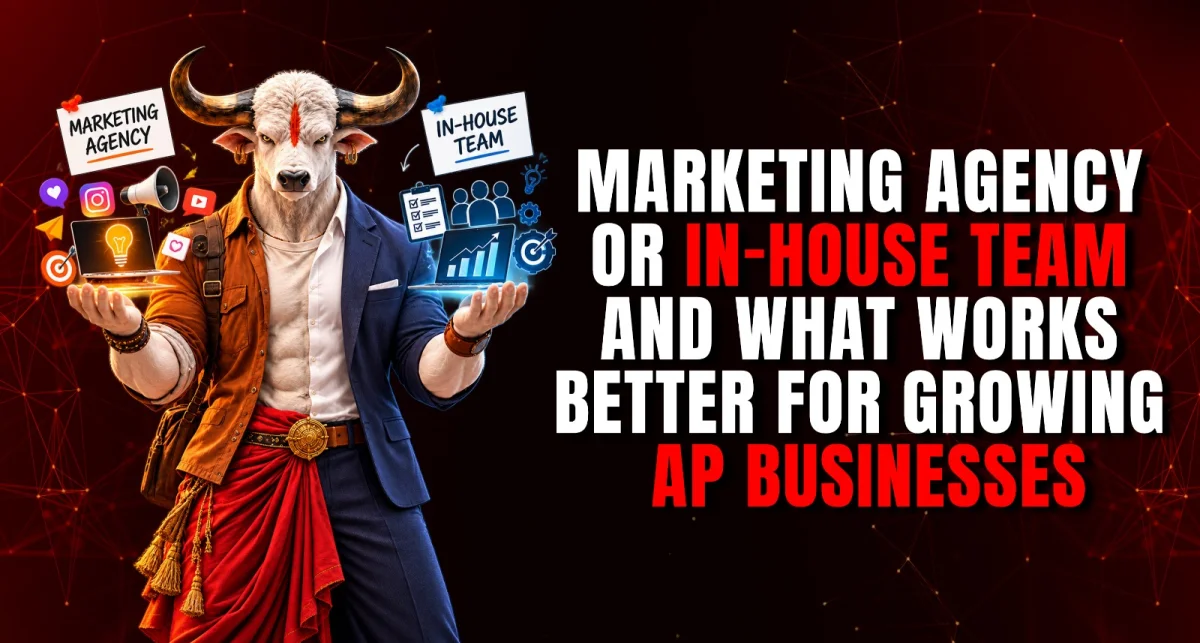
At some point every growing business in Andhra Pradesh hits the same fork. Marketing has outgrown the owner's evenings and the nephew who "knows Instagram." Do you hire a team, bring in an agency, or combine the two? Each answer can be right, and each can be an expensive mistake.
This article compares the two models honestly on cost, skills, speed, scalability, communication and accountability, and gives you a decision framework by growth stage. That way the marketing agency vs in-house team question gets settled by your situation rather than by whoever pitched you last.
Technical Avengers Pvt. Ltd. is a strategic growth agency Your Digital Task Force built on three forces: Business Consulting, Digital Strategy, and Advertisement. We work with businesses across Vijayawada, Amaravati, Guntur, Tadepalli, Mangalagiri and wider Andhra Pradesh. Full disclosure: we are an agency, so we have an obvious interest in one side of this question. We have tried to write the comparison we would want to read if we were on your side of the table.
The Question Behind the Question
"Agency or in-house?" sounds like a hiring question. It is really four questions:
Capability: Which skills do you need, and how many different ones?
Speed: How quickly do you need results to start?
Control: How closely do you need marketing woven into daily operations?
Cost: What can you afford, and how predictable does that cost need to be?
Most businesses answer the cost question first and the capability question last. That order causes most of the regret on both sides.
Also read: Why You Need a Business Consultant in Amaravati Before You Spend on Marketing
What Each Model Actually Gives You
Here is how the marketing agency vs in-house marketing team comparison looks, factor by factor.
Factor | In-house team | Marketing agency |
Cost structure | Fixed salaries plus tools, training and management time | Retainer or project fee, scalable up or down |
Breadth of skills | Limited to who you hire | Access to strategy, design, video, SEO, ads, web and analytics |
Speed to start | Slow: recruiting, onboarding, learning curve | Fast: established team and processes |
Brand and product knowledge | Deep and continuous | Built over time; depends on access you give |
Day-to-day availability | High, same building, same hours | Scheduled, with agreed response times |
Scalability | Hiring or firing to change capacity | Scope adjusts with your needs |
Accountability | Direct line management | Contract, scope and agreed metrics |
Continuity risk | One resignation can stall everything | Team cover built in, but switching agencies is disruptive |
Fresh perspective | Can become inward-looking | Sees patterns across many businesses |
Neither column wins outright. The right answer depends on which rows matter most to your business right now.
The Real Cost of an In-House Team
Salary is the visible part. Indicative 2026 salary data aggregated from AmbitionBox and other platforms puts a digital marketing executive in a non-metro city at roughly ₹2–3.2 lakh a year at entry level. A digital marketing manager with three to six years' experience in a non-metro city is roughly ₹4–7 lakh. Specialist roles cost more: mid-level performance marketers are often quoted at ₹9–13 lakh nationally.
Those figures are a starting point, not the full picture. In-house marketing team costs also include:
Recruitment time: often weeks to months of the owner's attention, plus the cost of a wrong hire
Tools and software: design, scheduling, SEO, analytics and editing subscriptions
Training: platforms like Meta and Google change constantly
Management time: someone has to set direction, review work and make decisions
Statutory and employment costs beyond the headline salary
Gaps: leave, resignations and notice periods, during which output stops
The bigger issue is breadth. Modern marketing needs strategy, copywriting, design, video, SEO, paid advertising, website work and analytics. One executive cannot be strong at all of them.
Most small in-house teams end up very good at one or two things, usually social posting, and quietly weak at the rest. That gap is where results stall.
The Real Cost of an Agency
Agencies have their own visible and hidden costs, and it is worth being honest about them.
Visible: a monthly retainer or project fee, separate from your ad spend. Pricing varies widely with scope, so compare what each fee actually covers rather than headline numbers.
Hidden:
Onboarding time: an agency needs to learn your business, customers and voice, and the first month or two involve your input
Communication overhead: approvals, feedback rounds and meetings take owner time
Less immersion: an agency will never be in your shop at 7 PM on a Saturday
Dependency: if the agency holds your ad accounts, website access or content files, switching becomes painful
Every one of those is manageable. Insist on owning your ad accounts, domain, website and content. Agree response times and a reporting cadence in writing.
Give the agency real access to customers and frontline staff. Outsourced marketing services work best when the agency is treated as part of the team, not as a vendor kept at arm's length.
When an Agency Usually Makes More Sense
You need several skills at once: strategy, design, video, SEO and ads, but cannot justify five hires
You need results to start quickly: a launch, a festive season, a new location
Your marketing needs fluctuate: heavy campaign periods followed by quieter months
You have no one senior to manage marketers: hiring juniors without direction rarely works
You want an outside view: patterns from many businesses and categories, not just your own
You are testing channels before committing to permanent hires in any one of them
When an In-House Team Usually Makes More Sense
Marketing is constant and high-volume: daily content, customer conversations and community management
Deep product knowledge is essential: complex technical products, regulated services, or a fast-changing catalogue
Speed of response matters hourly: live customer engagement, real-time offers, on-site event coverage
You already have a senior marketing leader who can direct a team
Scale justifies it: once marketing output is large enough, salaried specialists can cost less per unit of work
An honest note from our side: if your marketing is mostly one repeatable activity done at high volume every day, an in-house hire is often the better choice.
The Hybrid Model: Often the Best of Both
For many growing businesses in this state, the strongest setup is neither extreme. A small in-house team handles the daily, brand-close work, and an agency provides strategy, specialist skills and campaign capacity.
Work | Usually best in-house | Usually best with an agency |
Daily social posting and community replies | ✅ | |
Customer conversations on WhatsApp | ✅ | |
On-site photos and quick content | ✅ | |
Marketing strategy and planning | ✅ | |
Brand identity and positioning | ✅ | |
Website design and development | ✅ | |
SEO, AEO and local search | ✅ | |
Google and Meta advertising | ✅ | |
Professional video production | ✅ | |
Analytics, tracking and reporting | Shared | Shared |
The hybrid model works when roles are explicit: who owns what, who approves what, and which shared metrics everyone answers to. That clarity is the foundation of a sound business marketing strategy Andhra Pradesh companies can sustain as they grow.
Not sure which model fits your business right now?
Most owners we speak to are weighing exactly this decision. Do they hire, outsource, or combine the two, at their current budget and growth stage? The answer depends on specifics: what you already have, what you need over the next 6–12 months, and which skills are missing.
Our Client Discovery form is built around those questions. It covers your business stage, your goals, your current digital setup, and whether you have worked with agencies before. Our team reviews it and comes back with an honest recommendation. That might be a full agency engagement, specialist support for an in-house team, or a suggestion that you hire before you outsource.
→ Find the right marketing setup for your business
A Decision Framework by Growth Stage
Stage | Typical situation | Usually the better fit |
Idea or newly launched | Limited budget, many skills needed at once, no marketing lead | Agency or a focused freelancer for foundations; owner handles daily posting |
Growing | Revenue steady, marketing needs widening, owner stretched | Agency for strategy and specialist work; one in-house coordinator |
Established | Consistent demand, multiple channels, ongoing content needs | Hybrid: small in-house team plus agency specialists |
Scaling fast | Several locations or products, high daily volume | Larger in-house team led by a marketing head; agency for strategy, campaigns and specialist gaps |
For digital marketing for growing businesses, the most common mistake is jumping straight to an in-house junior hire at the "growing" stage. That hire is expected to deliver strategy, design, ads and SEO alone, with no one experienced to guide them. It usually disappoints both sides.
Questions to Ask Before You Decide
Whichever way you learn, these questions clarify the choice.
Which marketing skills do we need in the next 12 months, and how many are we missing?
Who in the business can set direction and judge marketing work?
How much of our marketing is daily and repeatable, versus campaign-based and specialist?
What is the true annual cost of the in-house option, including tools, management and gaps?
What exactly would an agency fee cover, and what would it not?
Who owns our ad accounts, website, domain and content under each option?
How will we measure success, and who is accountable for those numbers?
This Is Not Right for You If
You want to outsource and then disengage entirely. Agencies need your input, especially in the first months.
You want to hire one junior person to do everything. That setup rarely delivers, whichever model you pick around it.
You are choosing purely on the lowest monthly number. The cheapest option on paper often costs more in missed results.
You have no plan to measure outcomes. Without agreed metrics, neither model can be judged fairly.
Squad Deployment
Whether we work as your full marketing team or alongside your in-house staff, these are the specialists involved.
Unit | What it covers |
Brand strategy, positioning and identity | |
Social media strategy, or support and training for your in-house team | |
Website design and development | |
SEO, AEO, GEO and local search | |
Google and Meta advertising | |
Professional video and photography | |
Influencer and creator partnerships |
What to Measure, Whichever Model You Choose
Metric | Why it matters |
Qualified enquiries per month | The output marketing exists to produce |
Cost per acquisition | Makes cost comparisons between models fair |
Total marketing cost, all-in | Salaries, fees, tools and ad spend together |
Time to launch campaigns | Shows whether capacity matches your needs |
Owner hours spent on marketing | A hidden cost in both models |
Channel coverage | Which skills you actually have working for you |
Revenue attributed to marketing | The test that ends every debate |
Find the Right Marketing Solution for Your Business With Technical Avengers
The marketing agency vs in-house team decision is not permanent. Most businesses move between the models as they grow: agency-led at the start, hybrid in the middle, in-house-led at scale with specialists alongside. The goal is to choose the right setup for now, and to know what would make you change it.
As a digital marketing agency in Andhra Pradesh, we will tell you plainly if our model is not the right fit. That includes when a hire would serve you better, or when a hybrid arrangement makes more sense than a full retainer.
Find the right marketing solution for your business with Technical Avengers. You can also call +91 9030 218 219, admin@technicalavengers.com or explore our services.
Technical Avengers - Your Digital Task Force. From invisible to impossible to ignore.
FAQs
What is the main difference between a marketing agency vs in-house team?
An in-house team gives you dedicated people with deep brand knowledge and daily availability, at a fixed cost. An agency gives you a wider range of specialist skills and faster start-up, at a cost that can scale with your needs.
Is a marketing agency cheaper than an in-house team?
It depends on scope. For a business that needs several specialist skills, an agency is usually cheaper than hiring each one. For a business with high-volume, repeatable daily work, a salaried team can cost less per unit of output. Compare the marketing agency cost vs in-house team on an all-in basis.
What does an in-house marketing team cost in Andhra Pradesh?
Indicative 2026 data puts non-metro digital marketing executives at roughly ₹2–3.2 lakh a year at entry level, and mid-level managers at roughly ₹4–7 lakh. Add tools, training, management time, statutory costs and cover for gaps.
What is the best marketing team for small businesses?
Usually not a single junior hire is expected to do everything. Most small businesses do better with an agency or specialists for strategy and skills, plus the owner or one coordinator handling daily content.
When should a business build an in-house marketing team?
When marketing is constant and high-volume, deep product knowledge is essential, hourly responsiveness matters, and there is a senior leader to direct the team.
What is a hybrid marketing model?
An in-house team handles daily, brand-close work such as posting, customer conversations and on-site content. An agency provides strategy, design, web, SEO, advertising and video.
Should I own my ad accounts if I work with an agency?
Yes. Your ad accounts, website, domain, analytics and content should be in your business's name, with the agency given access.
How long does it take an agency to deliver results?
Setup and early campaigns can start within weeks. Search, content and brand-building results typically compound over three to six months.
Can an agency work alongside my in-house team?
Yes, and often very effectively. The key is defining who owns which tasks and agreeing shared metrics.