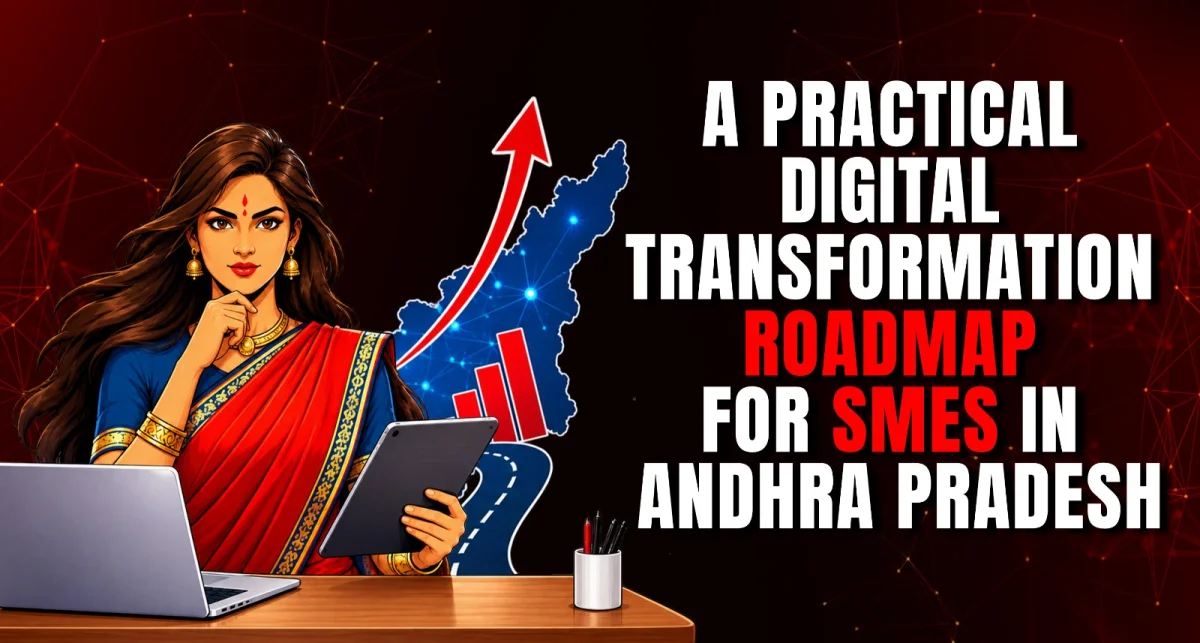
Ask an SME owner in Vijayawada, Guntur or Visakhapatnam what's slowing the business down and you'll often hear the same things: leads written in a notebook, invoices chased by phone, stock counted by hand, and a website nobody has updated in years. Most know they need to "go digital", but not where to start, what to buy first or how to manage the change without disrupting daily work. This guide sets out a practical roadmap for digital transformation for SMEs in Andhra Pradesh. It covers process assessment, digital presence, cloud tools, CRM, workflow automation, digital payments, data security, employee training and performance measurement, in a sequence you can manage within your budget.
Technical Avengers Pvt. Ltd. is a strategic growth agency — Your Digital Task Force — built on three forces: Business Consulting, Digital Strategy, and Advertisement. We help SMEs across Vijayawada, Amaravati, Guntur and wider Andhra Pradesh plan their digital roadmap, build their customer-facing digital presence and connect marketing to measurable growth. With Technical Avengers, every strategy hits like Thor's hammer — loud, bold, and unstoppable.
What Digital Transformation Actually Means for an SME
For a large company, digital transformation can mean multi-crore software projects. For an SME, it's simpler and more practical: using digital tools to remove the bottlenecks that cost you time, money and customers.
Area | Before | After |
Finding customers | Word of mouth, walk-ins | Website, Google profile, social media and ads bringing enquiries |
Handling leads | Notebook, memory, scattered WhatsApp chats | A CRM tracking every enquiry and follow-up |
Billing and payments | Manual invoices, cash, phone reminders | GST-ready cloud billing, UPI and payment links, automatic reminders |
Operations | Paper registers, spreadsheets on one PC | Cloud tools accessible from anywhere, shared by the team |
Decisions | Gut feeling | Simple dashboards showing sales, leads and cash flow |
Digital transformation for small businesses isn't about owning the most software. It's about fixing the right problems in the right order.
Why Buying Technology First Usually Fails
Many SMEs start by buying a tool a vendor recommended, or one a competitor uses. A few months later, it's half-used and the team has gone back to the old way. The usual reasons:
No clear problem to solve: the tool doesn't match how the business actually works
Too much at once: several new systems introduced in the same month
No training or ownership: nobody is responsible for making it stick
No measurement: nobody checks whether it saved time or made money
A sound digital transformation strategy India SMEs can follow starts with the business, not the software.
The Roadmap: 4 Stages Over 12 Months
Stage | Months | Focus |
1. Assess | 1–2 | Map processes, find bottlenecks, set goals and budget |
2. Foundations | 2–4 | Digital presence, digital payments, cloud tools |
3. Systems | 4–8 | CRM, workflow automation, integrations |
4. Grow and optimise | 8–12 | Digital marketing, dashboards, continuous improvement |
Running through every stage: data security and employee training.
Stage 1: Assess Before You Invest (Months 1–2)
Map how the business really works
Walk through two journeys step by step:
The customer journey: how people find you, enquire, buy, pay, receive the product or service, and come back
The internal journey: how orders are processed, stock is managed, invoices raised, payments collected and reports prepared
At each step, ask: where do things get delayed, lost, repeated or done by hand? Those are your transformation priorities.
Run a quick digital maturity check
Question | Yes / No |
Can customers find accurate information about you on Google and your website? | |
Are all enquiries recorded in one place, with follow-up dates? | |
Can customers pay digitally (UPI, cards, payment links)? | |
Is billing GST-ready and accessible beyond a single computer? | |
Can your team access files and data securely from anywhere? | |
Are repetitive tasks, such as reminders and confirmations, automated? | |
Is important data backed up automatically? | |
Do you review sales, leads and cash flow numbers monthly? |
Each "no" is a potential project. Rank them by business impact and ease of implementation.
Set goals and a realistic budget
Pick two or three measurable goals for the year, such as "respond to every enquiry within one hour", "cut payment collection time" or "double website enquiries". Budget for subscriptions, setup, training and some outside help, and phase spending across the year rather than all at once.
Stage 2: Build the Foundations (Months 2–4)
Strengthen your digital presence
Your website and Google Business Profile are where customers, suppliers and partners check you out. Make sure the website is fast on mobile, explains what you do clearly, shows contact options on every page and captures enquiries. A well-built business website and a properly optimised Google profile with local SEO become the front door for everything else in this roadmap.
Also read: 12 Must-Have Website Features That Turn Visitors Into Customers for AP Businesses — the checklist for a website that brings in enquiries.
Make digital payments the default
Customers expect to pay by UPI, cards or payment links. Display UPI QR codes at counters, send payment links with invoices, and add a payment gateway if you sell online. Digital payments speed up collections and make reconciliation easier.
Move core work to the cloud
Cloud solutions for small businesses let your team work from the shop, the office, the factory floor or home, with data stored securely and backed up:
Email, documents and file sharing through a business productivity suite
Cloud accounting and GST-ready billing, so invoices, expenses and reports are always up to date
Inventory and order management if you hold stock
Check compliance needs as you choose tools. For example, GST e-invoicing is mandatory for businesses whose aggregate annual turnover exceeds ₹5 crore, so your billing system should support it if you're near that level. These are the essential digital tools for SMEs. Start with what fixes your biggest bottleneck, not with everything at once.
Stage 3: Build Systems That Save Time (Months 4–8)
Implement a CRM
A CRM is where every lead, customer and follow-up lives. CRM software for small businesses should:
Capture enquiries automatically from your website, ads, WhatsApp and calls
Show each lead's stage, from new to contacted, quoted, won or lost
Set follow-up reminders so no enquiry is forgotten
Store customer history for repeat sales and service
Report on where leads come from and how many convert
Start simple. A CRM your team actually uses beats a powerful one that sits unused. Many SMEs begin with a well-structured shared sheet, then move to a dedicated CRM once the habit is built.
Not sure which tools your business actually needs?
Most SMEs we meet don't need more software. They need a clear plan that matches tools to real bottlenecks and a sensible order of implementation. Our team starts with a business and digital audit, then builds a practical roadmap that sets out what to fix first, what it should cost and how to measure it. We also build the customer-facing pieces ourselves, including your website, lead capture, marketing and tracking, and work alongside your accounting or IT vendors for the rest.
Tell us about your business through our Client Discovery form, and we'll recommend where your digital transformation should start.
→ Get a quote for your digital transformation roadmap
Automate repetitive work
Business process automation for SMEs focuses on tasks that are frequent, rule-based and time-consuming:
WhatsApp quick replies and auto-responses for common questions
Appointment, delivery and payment reminders sent automatically
Lead routing that sends new enquiries straight to the right salesperson
Low-stock alerts from your inventory system
Approval workflows for purchases, discounts or leave requests
Automate one process, check it works, then move to the next.
Connect your systems
The biggest time savings come when tools talk to each other: website forms flowing into the CRM, CRM deals creating invoices, payments updating accounts. Before buying any tool, check what it integrates with.
Stage 4: Grow and Optimise (Months 8–12)
Use digital marketing to feed the system
With a website, CRM and tracking in place, digital marketing for SMEs becomes far more effective, because every lead is captured and every rupee can be measured:
Search and local SEO to be found by people already looking
Social media to build trust and stay visible. A steady social media marketing calendar keeps you in front of customers.
Paid ads on Google and Meta for faster, measurable reach. Focused online advertising sends enquiries straight into your CRM.
Retention: WhatsApp updates, reminders and offers for existing customers
Build a simple dashboard
Bring your key numbers together monthly, from your CRM, accounts, website analytics and ads. A single page showing leads, conversions, sales, collections and costs is enough to make better decisions.
Running Through Every Stage: Data Security
Going digital means protecting more data. Basic steps every SME should take:
Two-factor authentication on email, banking, accounting and social media accounts
Role-based access, so staff see only what they need, and access is removed when someone leaves
Automatic backups of critical data, tested occasionally
Software updates applied promptly on computers and phones
Staff awareness of phishing messages, fake payment requests and suspicious links
Customer data handled with consent, in line with India's Digital Personal Data Protection Act. Its core notice and consent obligations for businesses come into force in May 2027 under the DPDP Rules.
For specialist security or compliance needs, take advice from a qualified IT security provider.
Running Through Every Stage: People and Training
Business technology adoption depends far more on people than on software:
Explain the why: show the team how the change makes their work easier
Pick a champion in each team to learn the tool first and help others
Train in the language people are comfortable with, whether Telugu or English, with short hands-on sessions
Write simple SOPs for each new process
Roll out in phases, keeping the old method only briefly as a backup
Celebrate early wins, such as time saved or faster payments
How to Prioritise by Business Type
Business type | Start with | Then add |
Retailer | Digital payments, Google profile, inventory system | CRM for repeat customers, WhatsApp updates |
Trader or distributor | Cloud billing, order management, payment reminders | CRM, dealer communication automation |
Manufacturer | Inventory and production tracking, cloud accounting | Website for B2B enquiries, CRM for buyers |
Service firm (consultants, agencies, CAs) | CRM, cloud documents, website | Automated scheduling, client reporting |
Clinic or healthcare provider | Online appointments, Google profile, digital payments | Automated reminders, patient feedback |
This is what practical SME digitalisation Andhra Pradesh businesses need: changes matched to how each type of business really runs.
Also read: Digital Business Blueprints: What Most Brands in Andhra Pradesh Are Still Missing — the blueprint behind a growth-ready digital business.
How to Measure Progress
KPI | What it shows |
Enquiry response time | Whether leads are handled faster |
Lead-to-customer conversion rate | Whether follow-up has improved |
Payment collection time | Whether digital billing and reminders are working |
Hours saved on manual tasks | Whether automation is paying off |
Billing or order error rate | Whether processes are more accurate |
Tool adoption rate | Whether the team is actually using new systems |
Revenue from digital channels | Whether your digital presence brings business |
Also read: 8 Marketing KPIs Every Vijayawada Business Owner Should Track — the marketing metrics behind digital growth.
Common Mistakes to Avoid
Buying tools before defining the problem.
Changing everything at once instead of in stages.
Skipping training and expecting the team to figure it out.
Ignoring security until something goes wrong.
Choosing tools that don't integrate, creating new silos.
Not measuring results, so nobody knows what worked.
This Is Not Right for You If
You want a single software package to fix everything overnight. Transformation happens in stages.
The owner and managers won't change how they work. Leadership has to model the new way.
You're looking for a full IT infrastructure or ERP implementation partner. We focus on strategy, digital presence, marketing and customer-facing systems, and work alongside specialist vendors for the rest.
You won't measure outcomes. Without measurement, it's impossible to know what's working.
Build a Practical Digital Transformation Plan With Technical Avengers
Successful digital transformation for SMEs in Andhra Pradesh isn't about buying the latest technology. It's about assessing how your business works, fixing the biggest bottlenecks first, building systems your team actually uses, protecting your data, and measuring the results. Done in stages, it's affordable, manageable and transformative.
If you'd like a clear, practical roadmap built around your business, our team is ready to help.
Build a practical digital transformation plan with Technical Avengers. You can also call +91 9030 218 219 or email admin@technicalavengers.com.
Technical Avengers — Your Digital Task Force. From invisible to impossible to ignore.