A good business does not automatically become a popular business. A restaurant can serve excellent food, a showroom can offer quality products, and a clinic can provide reliable care, yet potential customers may choose a competitor simply because they found that business first on Google or Instagram.
For businesses in Guntur, this is becoming an increasingly important challenge. Customers are using Google Search, Google Maps, Instagram, Facebook and WhatsApp to discover local brands, compare options and make purchasing decisions. If your business is not visible where these decisions happen, you could be missing valuable enquiries and sales.
The solution is not to spend money on every digital platform. It is to build a connected marketing system that helps people discover your business, understand your offerings, trust your brand and take action.
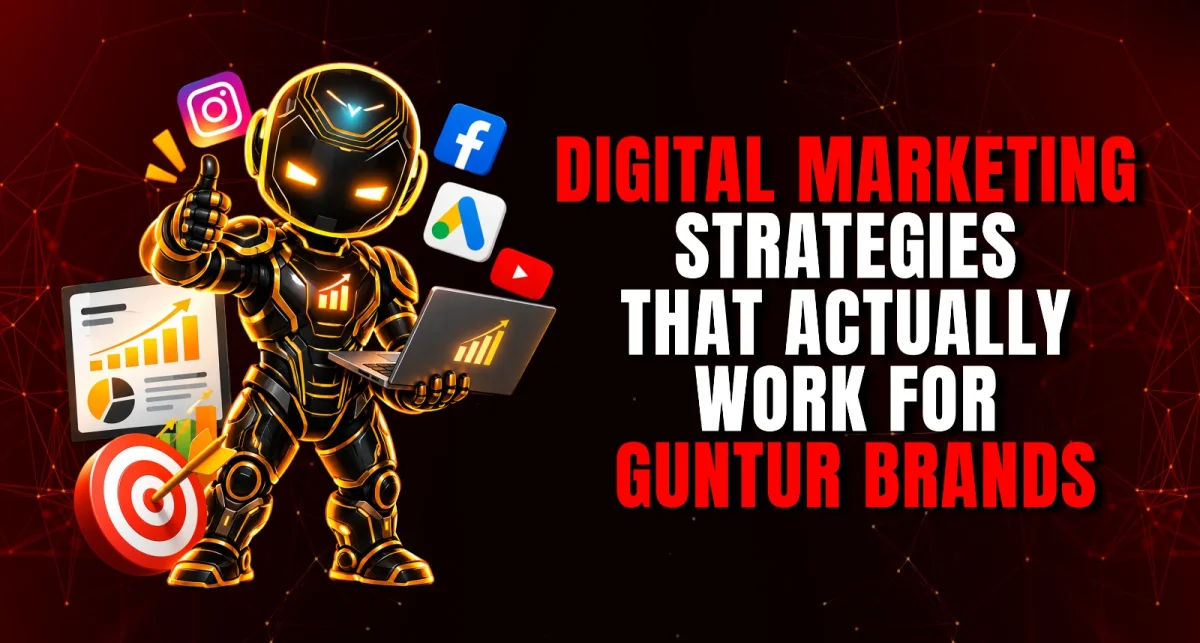
This guide explores practical digital marketing strategies for Guntur brands, covering local SEO, Google Business Profile optimisation, social media marketing, Google Ads, Meta Ads, short-form video, WhatsApp engagement and conversion-focused websites. It also explains how to measure results and choose the right channels according to your business goals.
At Technical Avengers, we help businesses across Guntur, Vijayawada, Amaravati, Tadepalli, Mangalagiri and wider Andhra Pradesh connect business strategy, digital marketing and advertising to achieve measurable growth.
Why Guntur Businesses Need a Strong Digital Marketing Strategy
Guntur has a diverse business environment, from retail stores and educational institutions to healthcare providers, restaurants, real estate companies and professional service businesses.
Customers in areas such as Brodipet, Lakshmipuram, Arundelpet and other commercial neighbourhoods increasingly have multiple options when choosing a product or service.
Consider a simple example.
Someone searching for a dental clinic in Guntur might compare three businesses on Google. They may check the location, reviews, photographs, services and appointment options before contacting anyone.
A clinic with an optimised Google Business Profile, useful website information and recent customer reviews has more opportunities to earn that enquiry than a competitor with an incomplete online presence.
This is how digital visibility influences business decisions.
However, visibility alone is not enough. A business also needs a clear offer, a trustworthy online presence and a process for converting enquiries into customers.
Three common problems hold local businesses back:
Low online visibility: Customers searching for relevant services cannot easily discover the business.
Unproductive advertising: Businesses spend on social media promotions without knowing whether campaigns generate genuine enquiries.
Poor enquiry conversion: Potential customers visit the website or send messages but do not receive timely responses or enough information to make a decision.
A practical digital marketing strategy addresses all three problems instead of focusing only on likes, followers or website traffic.
1. Build Local Visibility Through SEO and Google Search
Search engine optimisation is one of the most valuable long-term investments for a local business.
When customers search for services, they often use location-specific phrases such as:
Digital marketing agency in Guntur
Best restaurant in Guntur
Real estate developers in Guntur
Dental clinic near me
Coaching centres in Guntur
These searches indicate that users may already be looking for a business to contact or visit.
A well-planned SEO strategy helps your business appear for relevant searches and attract people with genuine interest.
Focus on location-specific keywords
Start by identifying the keywords your potential customers actually use.
For example, a real estate company could target:
Real Estate Company in Guntur
Residential Plots in Guntur
Apartments for Sale in Guntur
Property Developers in Guntur
A healthcare provider might focus on service-specific and location-specific searches, while a restaurant could target cuisine, dining and delivery-related searches.
Create dedicated website pages for important services instead of placing every keyword on the homepage.
Each page should explain the service, who it is for, what makes the business different and how customers can get in touch.
Optimise your website content
Your website should communicate clearly with both search engines and potential customers.
Important on-page SEO elements include:
SEO-friendly page titles and meta descriptions.
One clear H1 heading per page.
Relevant H2 and H3 headings.
Naturally placed primary and secondary keywords.
Internal links between related pages.
Descriptive image ALT text.
Relevant FAQs.
Appropriate LocalBusiness and other structured data.
Fast loading speed and mobile-friendly design.
Avoid creating multiple pages that repeat the same content with only the location name changed. Every location page should offer genuinely useful information.
Create useful local content
Publishing helpful articles can attract customers who are researching a product or service before making a decision.
For example, a property business could publish a guide to evaluating residential plots, while an educational institution could explain how students should choose a coaching programme.
This approach builds topical relevance and gives your audience a reason to visit your website.
SEO is not an overnight strategy. It requires consistent optimisation, useful content, technical improvements and ongoing performance monitoring.
2. Optimise Your Google Business Profile for Local Customers
Your Google Business Profile can be one of the most important digital assets for a business that depends on local customers.
When someone searches for a nearby service, Google may show local business listings with directions, contact details, photographs, ratings and reviews.
For many customers, this is their first interaction with your brand.
Essential Google Business Profile optimisation steps
Choose the correct business category: Select the primary category that most accurately describes your main business. Add relevant secondary categories where appropriate.
Complete your business information: Keep your business name, address, telephone number, website, operating hours and service details accurate.
Upload genuine photographs: Add clear images of your premises, team, products, services and completed projects. Update them regularly.
Add your services and products: Describe what customers can expect and include useful information wherever the available profile features allow it.
Publish regular updates: Share business announcements, offers, new services, events and relevant updates.
Encourage genuine customer reviews: Ask customers to share honest feedback after a purchase or service experience. Respond professionally to positive and negative reviews.
Why customer reviews matter
Imagine two businesses offering the same service in Guntur.
One has an incomplete profile and very few recent reviews. The other has accurate business information, genuine customer feedback and clear photographs.
Customers may feel more confident contacting the second business because they have more information to evaluate.
Remember that reviews should be genuine. Never purchase fake reviews or offer incentives in exchange for positive ratings.
A well-maintained profile supports local discovery, but it does not guarantee a particular Google ranking. Relevance, distance, prominence and other factors influence local results.
3. Use Social Media Marketing to Build Brand Awareness and Trust
Social media is not simply a platform for posting promotional designs. It is an opportunity to introduce your business, demonstrate your expertise and build relationships with potential customers.
For many consumer-facing businesses in Guntur, Instagram and Facebook can play important roles in the customer journey.
However, the content should match the audience and the business objective.
Build a content strategy around four categories
1. Educational content
Share information that helps your audience understand your products or services.
Examples:
A real estate company explaining property documentation.
A clinic sharing general preventive healthcare information.
A coaching institute publishing study tips.
A restaurant introducing ingredients and preparation methods.
2. Trust-building content
Show the people, processes and experiences behind your business.
Use team introductions, customer testimonials shared with permission, project updates and behind-the-scenes videos.
3. Promotional content
Communicate offers, new launches, seasonal campaigns and service packages.
Make sure every promotional post explains the value of the offer and provides a clear next step.
4. Engagement content
Use questions, polls, interactive stories and useful discussions to understand what your audience wants.
Create content in the language your audience understands
For businesses serving local customers, language can influence how easily people connect with a brand.
English, Telugu or a combination of both may be appropriate depending on the target audience.
For example, a local restaurant could use Telugu-led reels to introduce regional dishes, while a professional B2B company may prefer English content supported by informative graphics.
The objective is not to follow a language trend. It is to communicate clearly with the people most likely to become customers.
A consistent posting schedule, strong creative quality and relevant messaging are more valuable than publishing content every day without a clear purpose.
4. Run Google Ads to Reach Customers With High Purchase Intent
Organic SEO takes time to develop. Google Ads can help businesses reach potential customers who are actively searching for specific products or services.
This makes it particularly useful for businesses that need enquiries within a shorter timeframe.
For example, a person searching for a property consultant in Guntur may already have a specific requirement. A relevant search advertisement can introduce your business at the moment they are looking for assistance.
Build campaigns around customer intent
Avoid putting every service into one advertising campaign.
Instead, organise campaigns around different services, search intent and conversion goals.
A Guntur-based educational institution could create separate campaigns for:
Competitive examination coaching.
Intermediate education.
Entrance examination preparation.
Individual course enquiries.
Each campaign should have relevant keywords, advertisements and landing pages.
Improve your Google Ads performance
A successful campaign needs more than a good daily budget.
Focus on these areas:
Keyword selection: Target searches relevant to your actual products and services.
Negative keywords: Exclude irrelevant searches that consume advertising budget.
Location targeting: Focus on the areas where your business can realistically serve customers.
Ad copy: Explain the service, value proposition and next step clearly.
Landing pages: Send visitors to pages that match the advertisement.
Conversion tracking: Measure genuine calls, form submissions, bookings and other valuable actions.
Do not judge a Google Ads campaign only by impressions or clicks. A campaign that generates fewer but more qualified enquiries may deliver better business results than one producing large volumes of irrelevant traffic.
5. Use Meta Ads to Generate Enquiries on Facebook and Instagram
Facebook and Instagram advertising can help Guntur brands reach potential customers based on their location, interests and other available audience signals.
Unlike search advertising, where people often express an existing requirement, Meta Ads can introduce a business to people who may not be actively searching for it.
This makes the platform useful for brand awareness, product discovery, promotions, lead generation and remarketing.
Choose the right campaign objective
Your campaign objective should reflect the action you want customers to take.
For example:
Awareness: Introduce a new business, product or service.
Engagement: Encourage people to interact with your content.
Traffic: Direct potential customers to a website or landing page.
Leads: Collect enquiries through supported lead forms or messaging destinations.
Sales: Encourage purchases where the website and conversion setup support them.
Target the right audience
A business serving Guntur does not necessarily need to target the entire state.
Start with the locations that are commercially relevant to your business. Expand only when the data shows that wider targeting is useful.
For example, a local showroom may initially focus on customers within its practical service area, while an educational institution may target students and parents across a wider region.
Test different creative formats, audience groups and offers separately.
Measure the quality of leads
One common mistake is treating every form submission or messaging conversation as a successful lead.
A better approach is to track:
Total enquiries received.
Valid enquiries.
Qualified leads.
Follow-up completed.
Appointments or meetings booked.
Actual customers acquired.
Cost per acquired customer.
This helps identify whether your advertisements are attracting genuine potential customers or simply generating inexpensive but irrelevant interactions.
6. Invest in Short-Form Videos That Show Your Business in Action
Short-form videos have become an important content format for businesses that want to demonstrate products, services and customer experiences.
Reels, YouTube Shorts and similar formats give brands opportunities to communicate information quickly and visually.
For Guntur businesses, video content can make a local brand more familiar and approachable.
Video ideas for different industries
Business Type | Video Content Ideas |
Restaurants | Food preparation, signature dishes, kitchen experiences |
Real Estate | Property walkthroughs, construction progress, location highlights |
Healthcare | General health education, facility introductions, doctor-led information |
Education | Faculty introductions, course explanations, learning tips |
Retail | New arrivals, product demonstrations, styling ideas |
Professional Services | Expert advice, frequently asked questions, process explanations |
Follow a simple video structure
An effective short video can follow three stages:
Hook: Start with a question, problem or interesting statement that captures attention.
Value: Show the product, explain the service or provide useful information.
Call to action: Tell viewers what they should do next, such as visiting your website, calling your business or sending a WhatsApp enquiry.
For example, a real estate business could begin with:
"Planning to buy a residential plot in Guntur? Here are three things you should check before making a decision."
The video can then explain the checks and direct viewers towards a relevant service page.
Prioritise clear audio, good lighting, readable subtitles and authentic footage. A professional-looking video is useful, but a meaningful message is what gives it business value.
7. Turn WhatsApp Into a Customer Enquiry and Follow-Up Channel
For many local businesses, WhatsApp is where customer conversations actually happen.
A person may discover your brand through Google, view your Instagram page and then send a WhatsApp message to ask about pricing or availability.
If that conversation is not handled properly, the marketing opportunity may be lost.
Set up WhatsApp Business properly
Start with a complete business profile that includes:
Business name and description.
Address and operating hours.
Website and contact information.
Product or service catalogue, where relevant.
Greeting and away messages.
Quick replies for frequently asked questions.
Use labels to organise conversations into stages such as New Enquiry, Follow-Up Required, Interested, Booked and Converted.
Create a simple follow-up process
A practical process could look like this:
A customer sends an enquiry.
The business acknowledges the message promptly.
The team understands the customer's requirement.
Relevant pricing, information or options are shared.
A follow-up is scheduled if the customer needs more time.
The final outcome is recorded.
For businesses managing larger enquiry volumes, the WhatsApp Business Platform can support more structured communication and integrations, subject to its policies and setup requirements.
Only send promotional messages to customers who have provided the required consent. Make it easy for people to stop receiving marketing communications.
8. Build a Website That Converts Visitors Into Customers
Your website is where many of your marketing channels come together.
Google search, social media posts, video advertisements and paid campaigns can all direct people to your website.
But if the website is difficult to navigate, slow to load or unclear about the services you offer, visitors may leave without contacting you.
A conversion-focused website should answer four important questions:
What does your business offer?
Who are your services designed for?
Why should customers trust your business?
How can someone contact you?
Essential website features for Guntur brands
Mobile-friendly design: Make sure the website works smoothly on smartphones.
Clear service pages: Explain each major service separately with useful information.
Visible contact options: Include click-to-call and WhatsApp options where appropriate.
Strong calls to action: Use clear messages such as Book an Appointment, Request a Quote or Talk to Our Team.
Customer proof: Display genuine testimonials, case studies, qualifications and relevant project examples.
Fast loading: Optimise images, scripts and page elements to improve performance.
Analytics and tracking: Measure important visitor actions, not just page views.
Your website should not function as a digital brochure that simply describes your business. It should guide visitors towards a useful next step.
For a deeper website checklist, read our guide: 12 Must-Have Website Features That Turn Visitors Into Customers for AP Businesses.
9. Connect Every Marketing Channel Instead of Running Them Separately
The strongest digital marketing strategies do not depend on one platform.
They connect multiple channels to support the same customer journey.
Consider an example of a Guntur-based furniture showroom.
A potential customer discovers a product through an Instagram reel. They later search for the showroom on Google, check its location and customer reviews, and visit the website to explore available products.
After that, they send a WhatsApp message to ask about pricing and delivery.
Each platform has played a different role:
Channel | Role in the Customer Journey |
Instagram Reels | Product discovery and awareness |
Google Search | Brand discovery and consideration |
Google Business Profile | Local information and trust |
Website | Product details and conversion |
Enquiry and follow-up | |
Meta Remarketing | Re-engagement with interested audiences |
This is why a connected marketing strategy is more useful than randomly boosting posts or running unrelated advertisements.
Every channel should have a clear purpose, and the business should be able to understand how customers move from discovery to purchase.
Also read: How AP Businesses Can Win More Customers While Spending Less on Acquisition.
10. Track the Marketing KPIs That Actually Affect Business Growth
A business can receive thousands of social media views without generating meaningful sales.
That is why marketing performance should be measured using business outcomes rather than vanity metrics alone.
Start with these important KPIs:
KPI | What It Measures |
Website Traffic | Visitors coming to your website |
Qualified Leads | Enquiries that match your target customer profile |
Cost Per Lead (CPL) | Advertising spend divided by leads generated |
Conversion Rate | Percentage of visitors or leads completing a desired action |
Customer Acquisition Cost (CAC) | Total acquisition expenditure divided by new customers |
Return on Ad Spend (ROAS) | Revenue attributed to advertising divided by ad spend |
Lead-to-Customer Rate | Percentage of leads that become paying customers |
Repeat Purchase Rate | Percentage of customers who purchase again |
For example, imagine a business spends ₹20,000 on advertising and receives 100 enquiries.
Its cost per enquiry is ₹200.
However, if only 20 enquiries are qualified, the cost per qualified lead is ₹1,000.
If five of those qualified leads become customers, the advertising cost per acquired customer is ₹4,000.
This example is illustrative, but it highlights an important difference: inexpensive enquiries do not always mean profitable marketing.
Businesses should also measure the revenue, margins and repeat purchases associated with the customers they acquire.
For a more detailed explanation, read 8 Marketing KPIs Every Vijayawada Business Owner Should Track.
A Practical 90-Day Digital Marketing Plan for Guntur Businesses
Instead of launching every marketing activity simultaneously, divide your work into three manageable phases.
Phase 1: Build the Foundation (Days 1–30)
Start by understanding the current position of your business.
Audit your website and existing social media profiles.
Research relevant local and service-specific keywords.
Optimise your Google Business Profile.
Improve important website pages.
Set up Google Analytics 4 and relevant conversion tracking.
Review your existing customer acquisition process.
Identify your main competitors and their online positioning.
Expected outcome: A stronger digital foundation with clear business goals and measurable starting points.
Phase 2: Build Visibility and Generate Interest (Days 31–60)
Once the foundation is ready, start building a consistent online presence.
Publish useful SEO-focused website content.
Follow a structured social media calendar.
Create short-form videos.
Develop location-specific website content where appropriate.
Start collecting genuine customer reviews.
Test Google Search and Meta advertising campaigns.
Set up a WhatsApp enquiry and follow-up process.
Expected outcome: Better visibility, more relevant audience engagement and initial opportunities for qualified enquiries.
Phase 3: Optimise and Scale (Days 61–90)
The final phase focuses on improving performance using actual campaign data.
Identify the channels generating qualified enquiries.
Review cost per lead and cost per customer.
Improve advertisements with weak performance.
Test new creative formats and relevant audience groups.
Improve landing page conversion rates.
Build remarketing campaigns where appropriate.
Review lead response times and follow-up quality.
Reallocate budget towards channels producing sustainable results.
Expected outcome: A more organised marketing system with better visibility into customer acquisition and campaign performance.
The timeline is a working framework, not a guarantee of rankings, leads or revenue within 90 days. Results depend on the industry, competition, budget, execution and sales process.
How to Choose the Right Digital Marketing Channels for Your Business
Not every business needs every marketing channel.
Your choice should depend on your audience, sales cycle, budget and primary business objective.
Business Type | Recommended Marketing Priorities |
Restaurants and Cafés | Google Business Profile, Instagram, Reels, local SEO and Meta Ads |
Real Estate | SEO, Google Ads, Meta lead generation, property videos and landing pages |
Healthcare | Local SEO, Google Business Profile, informative content and professional website |
Educational Institutions | Google Ads, Meta Ads, SEO, admission-focused landing pages and video content |
Retail and Showrooms | Instagram, Facebook, local SEO, product videos and remarketing |
Professional Services | SEO, website optimisation, Google Search Ads, LinkedIn and trust-building content |
These are starting points rather than fixed rules. Campaigns in regulated sectors, including healthcare and education, should also follow the applicable advertising and professional guidelines.
If you are unsure where to begin, start with the channel that best matches how your customers discover and evaluate your service.
For a broader business growth roadmap, explore The 12-Month Digital Growth Plan Every Andhra Pradesh Business Needs for 2027.
Why Choose Technical Avengers for Digital Marketing Services in Guntur?
Choosing a digital marketing partner is not simply about finding someone who can create social media posts or run advertisements.
Your business needs a team that understands the connection between marketing activity, customer acquisition and business growth.
Technical Avengers Pvt. Ltd. is a strategic growth agency built around three forces: Business Consulting, Digital Strategy and Advertisement.
We work with businesses across Guntur, Vijayawada, Amaravati, Tadepalli, Mangalagiri and wider Andhra Pradesh.
Our services bring together different parts of the digital growth process:
SEO and Local SEO: Improve organic search visibility and help customers discover your business.
Social Media Marketing: Build a consistent brand presence through relevant content and audience engagement.
Google Ads Management: Reach customers actively searching for your products and services.
Meta Ads Management: Develop Facebook and Instagram campaigns for awareness, lead generation and sales.
Website Development: Create responsive, user-friendly websites designed to convert visitors.
Video Production: Develop engaging videos for social media, advertising and brand communication.
Influencer Marketing: Connect with relevant creators and audiences through suitable collaborations.
Digital Strategy: Align your marketing activities with your business objectives and growth priorities.
We believe effective marketing should have a clear purpose. Every campaign should connect to a measurable business objective, whether that is increasing qualified enquiries, improving local visibility, generating appointments or growing sales.
Grow Your Guntur Business With a Result-Focused Digital Marketing Strategy From Technical Avengers
Your competitors are already working to reach customers online. The question is whether your business has a clear strategy to compete.
If you are looking for digital marketing services in Guntur, Technical Avengers can help you identify the right channels, build a practical marketing roadmap and execute campaigns around your business goals.
Let's build a digital growth strategy that works for your business.
Visit Technical Avengers or call +91 90302 18219 to discuss your requirements.
Technical Avengers — Your Digital Task Force.
FAQs
1. What are the best digital marketing strategies for businesses in Guntur?
The most useful strategies depend on the industry and business objectives. Local SEO, Google Business Profile optimisation, social media marketing, Google Ads, Meta Ads, short-form video and WhatsApp engagement are important options for many local businesses.
2. How can I find the right digital marketing agency in Guntur?
Look for an agency that understands your industry, has a clear strategy, explains its deliverables, provides transparent reporting and measures meaningful business outcomes. Ask how it tracks qualified leads, conversions and customer acquisition costs.
3. How much should a Guntur business spend on digital marketing?
There is no universal marketing budget. It depends on your industry, competition, customer acquisition targets and available resources. Start with a sustainable budget, test relevant channels and increase spending when you can demonstrate that campaigns are producing valuable customers.
4. Is SEO better than Google Ads for local businesses?
Both serve different purposes. SEO helps build long-term organic visibility, while Google Ads can bring faster exposure to relevant searches. Many businesses benefit from using both as part of a connected strategy.
5. How long does local SEO take to show results?
SEO results vary according to competition, website quality, current authority, technical issues and the quality of optimisation. Some improvements may become visible relatively quickly, while meaningful and consistent organic growth often takes several months.
6. Are Meta Ads effective for businesses in Guntur?
Yes. Meta Ads can help businesses reach relevant audiences through Facebook and Instagram. Their effectiveness depends on campaign objectives, creative quality, audience selection, offer relevance, conversion tracking and lead follow-up.
7. Does my business need a website if I already have Instagram?
For most businesses, having a website is valuable. Instagram helps with discovery and engagement, while a website provides a platform you control for explaining services, building search visibility, presenting credibility and collecting enquiries.
8. How can I generate quality leads instead of just more enquiries?
Define your ideal customer, use relevant targeting, communicate a clear offer, build focused landing pages and qualify enquiries based on genuine requirements. Track how many leads become customers instead of judging campaigns only by lead volume.
9. Is WhatsApp useful for local business marketing?
Yes. WhatsApp Business can help manage enquiries, answer common questions, share product information and follow up with potential customers. Businesses should use it responsibly and obtain appropriate consent for promotional communication.
10. Why should I choose Technical Avengers?
Technical Avengers combines business consulting, digital strategy and advertising with services including SEO, social media marketing, paid advertising, website development and video production. The focus is on building marketing systems around measurable business objectives.
11. Can digital marketing help a small business compete with established brands?
Yes. A small business can compete by targeting relevant customer groups, strengthening local search visibility, building trust through genuine reviews, creating useful content and managing advertising efficiently. A focused strategy is often more valuable than trying to match a larger competitor's spending.
12. How do I get started with Technical Avengers?
Visit https://www.technicalavengers.com/ or call +91 90302 18219 to discuss your business goals and explore a digital marketing strategy for your brand in Guntur.